Saturday, May 17, 2014

Sailing to Princess Louisa Inlet - Part III: The Arrival

Note:  For parts one and two of this trip log scroll down or click on the link you want to the left of this page.  A 30 minute HD video summary of the trip is below:


I awoke the next morning to the sounds of David going through the morning routine of putting coffee on and turning on the diesel heater to take the chill off the cabin.  Normally he waits for me to crawl out of my bunk and do this but due to the excesses of the previous night I was slow to wake up.  A bacon and egg breakfast seemed like a good idea but I couldn't contemplate such a complex task for a little while.  I sat in the cockpit with a cup of hot coffee and a bottle of water and watched the current race by the dock.

The dock at the Backeddy Marina, near Egmont

There were signs around advertising diving expeditions and it occurred to me that the drift diving must be very good here.  Drift diving is a way of scuba diving that involves descending and drifting with the current, usually along a steep wall and being picked up by a boat somewhere downstream.  In BC this type of diving is popular because narrow channels with significant current and tidal exchange tend to teem with marine flora, due to the rich nutrients regularly supplied by the fast running water.  I recall doing a drift dive in a place called Dodds Narrows near Nanaimo.  As we prepared to jump in the water a fishing boat captain stopped beside us and was incredulous that we would be diving in a place with such strong currents and high boat traffic.  Later, as I glided along in the murky depths and listened to the throb of tug boats above me, I had to agree.  All that to see a few anemones and nudibranchs.  But I digress...


At the fuel dock

After a time I wandered up to the showers with my kit bag and got myself cleaned up.  Emerging a while later with head and teeth feeling a little less fuzzy I was ready to get under way.  The marina offered wifi here so David and I sent some messages and made some FaceTime calls before we left, knowing we would be completely out of touch for a few days.  Before leaving we brought the boat to the other side of the dock to top up our water at the fuel dock.  I suggested we top off our fuel as well but David didn't want to.  He keeps detailed records of how many hours we log on the engine and prides himself on knowing exactly how long we have until we run out of diesel.  It is a personal affront to him to suggest that we "get gas" until he declares that his calculations deem it necessary.  I predict that one day this will bite us both in the arse.

Leaving the Backeddy.  We lingered off the dock for a few
moments to take final advantage of wifi from the marina.

After pulling away from the Backeddy and turning up Jervis Inlet we set the autopilot and settled in for a long motor.  I went below and prepared a hot breakfast which I was now very much looking forward to.  There is nothing quite so comforting while underway in the boat as a steaming plate of bacon and scrambled eggs with a large hot cup of coffee.  A gourmet meal could not have tasted any better.

Breakfast underway
We knew the weather for this trip would be a mixed bag and today the clouds hung low in the air.  In some cases they obscured the peaks of the mountains we were passing but they gave the scenery an otherworldly feel - something out of Game of Thrones.  The time passed more quickly than if we were motoring in the open ocean because much of the time we kept close to shore and occupied ourselves looking at the myriad waterfalls and other interesting land features.


As the day wore on the clouds began to lift and the mountain peaks grew higher and more impressive.      Soon we could see Malibu Lodge in our binoculars, marking the entrance to Malibu rapids - the gateway to Princess Louisa Inlet.  The lodge was quite literally dwarfed by the surrounding mountains.  The very narrow entrance to PLI that is Malibu rapids was enough to prevent Captain George Vancouver from entering the fjord and to this day it dictates when transit can be made.  As we approached we noticed another sailboat anchored nearby, clearly waiting for the slack.  As we passed, they left their anchorage and followed us toward the entrance.

Malibu lodge is dwarfed by the surrounding mountains. (center)

A quick sail across Jervis to visit a waterfall


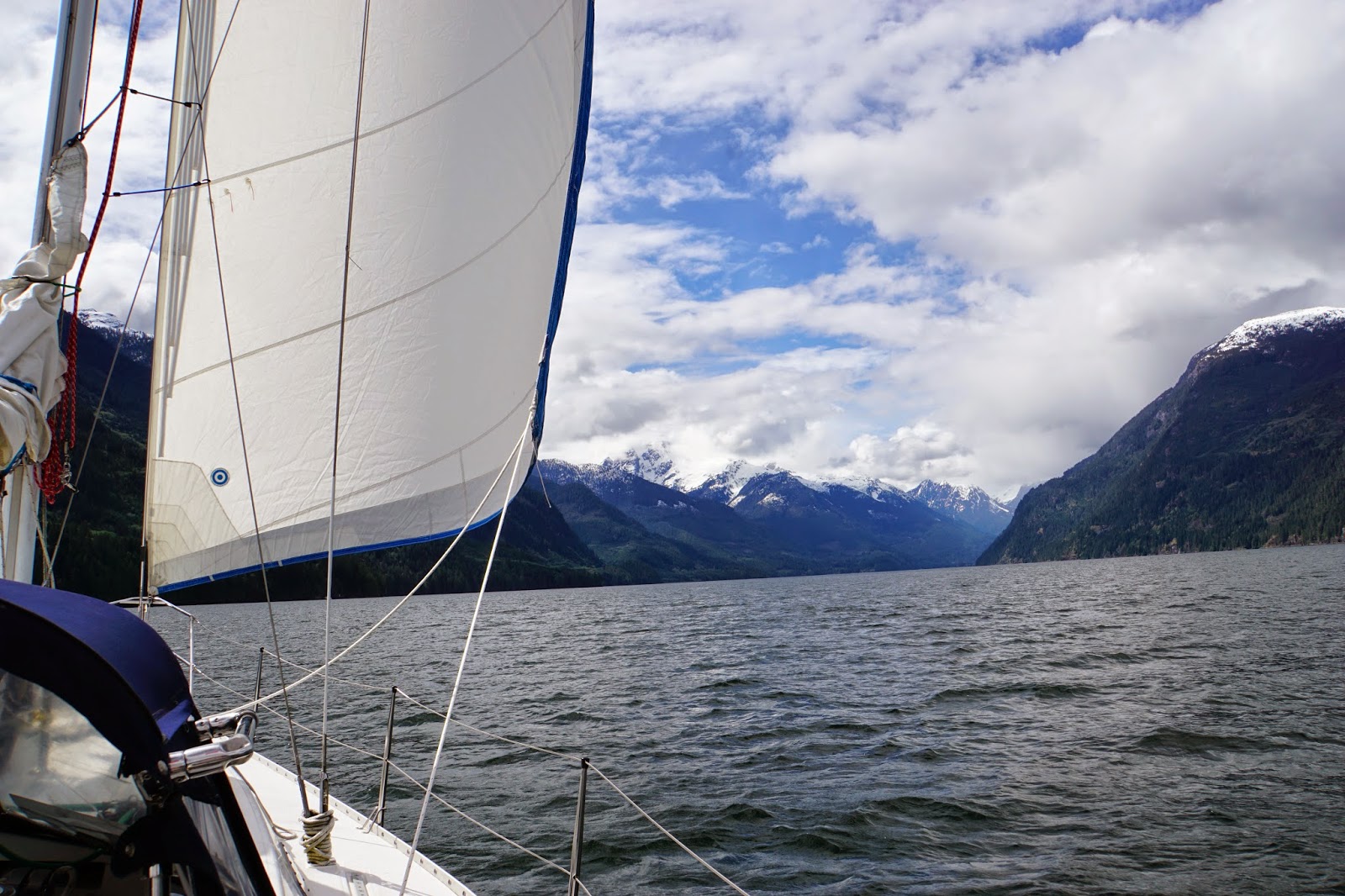
With a bit of time to kill we decided to wander over to a large waterfall we had spotted on the opposite side of Jervis from Malibu Rapids.  A nice breeze was blowing and in crossing the inlet we could take it off our beam so we pulled out the headsail, shut off the motor and drifted pleasantly over to have a look.  Having done this and taken a few pictures we turned back toward PLI to see our sailboat friend entering the rapids.  A few moments later we followed him in.  There was still a bit of current left in the ebb but the entrance was otherwise calm and we enjoyed slowly motoring through and taking in the emerging scenery.  Words can't really do justice to the experience of entering PLI.  The mountains soar to thousands of feet on either side, their white snowy caps contrasting sharply with the now deep-blue sky.   Waterfalls are everywhere.  Eagles drift overhead.  The shoreline, exposed by low tide, is encrusted with thousands of purple sea stars.  Speaking later to someone at the dock he would comment that "It's hard to be an atheist when you come to this place."  However you understand and appreciate nature, you will definitely appreciate it here.


Princess Louisa Inlet is several miles long.  The primary destination for most boaters is the end of the fjord where Chatterbox falls comes thundering down from the mountains and frothing into the ocean. BC Parks maintains a long dock here and there are public structures ashore such as outhouses and a gazebo with fire pit.  There is another area set aside for boaters with several mooring buoys about halfway up the inlet adjacent to MacDonald Island.  We took note of this place on our way in but like everyone else, we had to experience the marquis view of Chatterbox falls.  As the falls and the dock came into view, we were slightly disappointed to see a couple of large powerboats tied up there.

It's hard to describe the relationship between sailors and power-boaters.  It can range from being cordial to downright adversarial.  Most would agree that beyond our mutual love of the water, there is a different ethos driving each.  Sailors tend towards minimalism, quietness and simplicity, at one with nature.  Power boaters lean toward comfort and dominance over nature, much like an RV in a remote campground.  Whereas most sailors will content themselves with whatever luxuries they can contrive with the power in their batteries or generate with solar panels,  powerboats typically use diesel generators.  Incredibly, many powerboats today actually shun propane power for stoves and fridges and use electric ranges that need generators to run.  I'm not saying this is wrong but it runs contrary to the sensibilities of most sailors.

And so we tied up at the dock, next to a couple of our sailing brethren, our view of Chatterbox effectively blocked by the large power yacht in front of us.  Later we traded polite smiles and nods with the power boat owners but it was the sailors with whom we fell into animated conversation.

Chatterbox falls with the public dock to the right


Later that evening we sat drinking wine and digesting our dinner, contemplating yet another sailing milestone reached.  This had seemed like such a daunting trip last year when we first bought the boat but now, here we were.  I could have sat for hours under the stars reflecting on this and many other things but the long day and fresh air dictated otherwise.  No sooner had darkness fallen than we were asleep in our bunks.  It had been quite a day.


Friday, May 16, 2014

Sailing to Princess Louisa Inlet - Part II - Egmont

Note:  Please scroll down for part 1 of Sailing to Princess Louisa Inlet

As we left the narrow mouth of Smugglers Cove, a huge splash in the bay in front of us startled us both.  My assumption as I dove into the cabin for my camera was that we had seen the splash of a humpback whale breaching.  But by the time I had my lens cap off and zoomed in for a closer look it was clear we were seeing something even more rare - a pod of orcas.

I have lived in British Columbia for 28 years and in that time I have seen a pod of orcas twice - while I was on a ferry to Vancouver Island.  The next sighting was last summer in Porlier Pass, but it was so brief I couldn't even get a picture.  This day however, was a different story.  The pod, consisting of what appeared to be 2 adults and 3 - 4 juveniles, was surfacing regularly in the same area, apparently unperturbed by the presence of our boat.  When we reached a respectable distance we stopped the boat and took pictures.


A few days earlier I had given in to a lingering temptation and purchased a new Sony A6000 camera with a 10:200 zoom lens.  At the time I was feeling a little guilty for the purchase as I'm not much of a photographer.  Now I was thankful as I snapped away trying to get that perfect shot.  As it happens, the perfect shot eluded me as I missed the few times the whales actually breached but I did manage some reasonably good shots of the adults surfacing and blowing.

After a while we left the whales to their business and we raised our sails.  The wind was still blowing from the south but at this time of the morning the sea was quite calm.  We set up the sails in a wing-on-wing configuration and had a wonderful sail northward towards the entrance to Agamemnon Channel.  Wing-on-wing can be a fussy and even dangerous way to sail because following waves will often hit the stern quarter and push the boat off course.  When this happens, one of the sails will lose the wind and collapse.  At best this is irritating and requires constant input at the helm, at worst, the boom can fly over to the opposite side of the boat, potentially damaging the rig or injuring someone.  As a precaution I had rigged a preventer.  This is simply a line tied from the rail to the boom to prevent it from swinging if the wind shifts.  Today however, it was largely unnecessary as the sea was calm and we ghosted along with the wind at 5 - 6kts.  Under these conditions it often feels like the boat is hardly moving at all until one looks at the GPS for confirmation of how quickly you're actually moving.


Eventually we made our turn up Agamemnon Channel and lost the wind.  We brought in the sails and motored up the channel toward Sechelt Inlet and our destination, the Backeddy Marina, near Egmont.  The town of Egmont features two marinas, the Backeddy being the closest to the mouth of Jervis Inlet, where we wanted to go.  Egmont is actually the last stop for fuel and provisions on the way to Princess Louisa.  As a result it is a popular stopping place in the summer for everything from sailboats to mega-yachts on their way to PLI.  The only challenge is that the Backeddy is positioned at the mouth of Sechelt Inlet and is subject to the significant tidal current flowing in and out of the inlet.  Currents can reach an amazing 16kts at nearby Skookumchuk narrows.  Contrary to what its name implies, the Backeddy is not really that well protected from these currents.  The guest dock is on the outermost edge of the marina, extending well out into the current.  All of this to say, arrival and departure from the Backeddy must be timed with slack tide.  Ge'Mara can only steam at 6kts under full power so attempting to enter the channel with anything more than a couple of knots of current is foolhardy and at times downright impossible.

We had an hour or more to kill while waiting for slack tide so we passed the entrance to Sechelt Inlet and went on to explore nearby Goliath Bay.  We had looked at this spot on the map as a possible alternative to tying up at a marina.  On closer inspection we confirmed what others had reported:  there are very few good anchoring spots in Jervis inlet and Goliath Bay wasn't much of an exception. Part of the problem is the steep terrain of the area.  As one might expect, a steep mountainside continues to be steep as it enters the water and as a result the shore provides little or no opportunity to anchor.  When we turned back towards Egmont we passed a small island and were surprised to find a large group of seals and sea lions lounging on the rocks.  We made a couple of slow passes and took pictures while they barked away at us.


A short while later we arrived at the Backeddy, the current having finally been tamed for a while.  David is familiar with this marina as he has a friend with a cottage in the area.  The two of them have whiled away a few hours in the marina pub in years past while waiting for a ferry.  And so it was that after tying up we checked in at the marina office and then checked in at the pub.  Before long we were commiserating over a pints of a stunningly good beer by local brewer Townsite called Suncoast Ale.  As we chatted with the marina office manager who had now made her way to the bar, one beer turned into several, followed by Irish whiskey.  We ordered excellent cheeseburgers and more beers.  Eventually we said our goodbyes and made our way back to the boat, whereupon David collapsed into his bunk and started snoring loudly.  I wasn't feeling tired and after poking around the boat for a while I unwisely decided to head back up to the pub.  And in the words of Forest Gump, "that's all I have to say about that."


Thursday, May 15, 2014

Sailing to Princess Louisa Inlet - Part I - Smugglers Cove


Note:  As an alternative or complement to this blog, check out the 30 min YouTube video of our trip above.

The cruising guide Waggoner refers to Princess Louisa Inlet as the "holy grail" of northwest cruising destinations.  This is not an exaggeration.   This stunningly beautiful fiord is far enough away from everything to be unspoilt  but close enough to Vancouver be accessible to a determined sailor with a week to spare.  David and I had been hearing about this special spot ever since we started sailing and this spring was our time to see it for ourselves.

First a little history:
Princess Louisa Inlet (PLI) is located near the top of Jervis Inlet on the BC coast.  The narrow entrance to PLI was first identified by Captain George Vancouver in 1792 while he was looking for the Northwest Passage.  At the time the tide was ebbing and what we now know as Malibu Rapids presented a formidable (if temporary) barrier so he simply noted it and moved on.  It wasn't until 1860 that Captain George Richards surveyed and mapped PLI and its surrounding features.

In 1919, the core of PLI was purchased by James "Mac" MacDonald.  He came to cherish the spot so much that in 1953 he donated the land to the Princess Louisa Preservation Society to ensure it remained in its pristine state for the enjoyment of future generations.  In 1964 it was acquired by BC parks and has remained protected land ever since.  The only hint of private development is the lodge that is built at the entrance adjacent to Malibu rapids.  Once catering to Hollywood stars and elite businessmen, it was closed after a polio outbreak and remained so until being purchased and reopened as a youth camp.  The PLI Preservation Society still exists and its followers are a dedicated group.  Some still talk fondly of playing bridge with Mac MacDonald and spending long summers there years ago.

                                                   *********************

We set off for PLI on a beautiful May morning with blue skies and unseasonably warm temperatures. There was a good southeast wind blowing which we considered to be a blessing on our trip because it would push us downwind all the way up to our first destination, Smugglers Cove.  It wasn't long before the clouds crept in but temperatures stayed comfortably warm.  Additionally, sailing downwind always feels like there is little or no wind at all so it was a very pleasant sail indeed.


Given how much thought we put into the decision to purchase an autopilot, it didn't take long for us to embrace the new addition.  In a word, we love it.  For anyone reading this who might be sailing without an autopilot, we heartily recommend it.  No sooner than we emerged from First Narrows, we had the autopilot engaged and took advantage of the freedom it offered to move around.

The new autopilot was even better than we imagined

There isn't much to report about this leg of the trip.  It was just a languid day of sailing and catching up with each other.  Meals are an important part of breaking up a day on the boat and so I was glad when David offered to go below and prepare bunwiches and tea for lunch.  A while later he handed up my plate and I looked at it with more than a trace of disappointment.  Inside the ample white Portugese bun was the most meagre offering of sliced ham ever served.  With some mouthfuls the meat was almost undetectable.  For context, one of my favourite meals while traveling in New York City is a pastrami sandwich from a good Jewish deli.  Here the meat is piled high and rightly it is the bread that is dwarfed by meat, not the other way around.  I asked David why we were rationing the meat and for some reason this struck him as funny.  He spent the next hour lapsing into spontaneous fits of private laughter at my expense.  I didn't feel like going below and pulling everything out of the fridge to salvage my sandwich so instead I soldiered through it, taking copious gulps of water in order to swallow the disproportionately large mouthfuls of bread.  I made a note to do the cooking from there on.

When we arrived in Smugglers Cove David immediately offered to go out in the dinghy to run the line for our stern tie.  I think he was still smarting from my stinging rebuke last year when he wasn't paying the line out fast enough so he thought he'd take the other job instead.  As he rowed ashore I payed the line out smoothly and wondered what could be so hard about it.  I decided I would pay him back for last year so I planned to jerk the line short repeatedly as he rowed back to the boat.  However in the end I didn't need to bother as he made life difficult enough for himself.  One of the oar locks in the dinghy is broken and won't hold an oar.  There are others but rather than work this out David got frustrated and decided to make it back to the boat with only one oar.  The comedy that ensued was better than anything I could have created by jerking the line short.  But I did it once just for good measure.

David managing our stern line with just one paddle


That night a gentle rain fell and when we awoke there was still something between rain and mist falling on this most serene little anchorage.  I had just purchased a new camera so this morning there was ample opportunity to experiment with it.  As the morning progressed the sun shone in beneath the rain clouds and provided some dramatic lighting for additional photos.  I had to force myself to put the camera down and just enjoy the moment while sipping a hot cup of coffee.


Before long it was time to go and after cleaning up we retrieved our anchor and stern line and set off. Emerging from the cove we were just considering when to set the sails when we saw a huge splash dead ahead.  We were in for a treat...

Sunday, April 27, 2014

DIY (Do it Yourself)

Most boaters you come across tend to be fairly handy folk.  I'm not really sure whether owning a boat makes one handy or if handy people are the ones who end up buying boats but I'm hoping it's the former.  So far, David and I have avoided messing with key systems too much and instead have deferred to Laurence, our trusty boat mechanic and general Jack Of All Trades.  In many cases I think this is a good thing as ill-informed bumbling with equipment can end up being more expensive than simply hiring an expert.  With that said, there are some things you just need to learn to do.

One of the biggest ongoing headaches on a sailboat is the marine head (toilet).  They are notoriously unreliable and when they start to malfunction it is immediately unpleasant for everyone.  And so it is that one of the first onboard systems that any boater will learn to fix is the head.  David and I have successfully deferred learning about this in our first year and Laurence has gamely performed whatever maintenance has been necessary.  Recently, however, he has been more reluctant.  If I remember correctly he said something like "I'm not fixing your head any more."  This was fine at the time because the head was working reasonably well but it was soon to become a problem.

A marine head is a nice convenience but needs constant attention

Over the last week we've been noticing that water has been backing up in to the bowl.  At first we thought it was seawater but when I visited the boat yesterday, the smell that greeted me made it clear that water was backing up from the holding tank.  The timing for this was not good because David and I are due to leave for our trip to Princess Louisa Inlet in 5 days and I have a day sail planned with some friends before that.  I immediately called Laurence even though I knew he would be reluctant.  To my dismay his schedule was totally booked and he didn't know anyone else who could help us on short notice.

Based on the nature of the problem we agreed it was probably the Joker Valve.  The Joker Valve is a simple rubber plug that allows water to flow through it in one direction but not the other.  More specifically, it allows waste and water to be pumped out of the bowl and into the tank while not allowing it to come back the other way.  These little devices are as simple as they are unreliable and it is widely known among boaters that they need to be replaced at least once a year.  I knew after speaking with Laurence that if we wanted to sail this week, I was going to have to fix the head myself.  There was simply no other way.

A joker valve.  Every boat owner
will eventually know what it is.

Dutifully I went to the chandlery and purchased the Joker Valve.  There was no question of them having stock - they guy told me it is the single most requested item they have.  I went home and did what any self respecting handyman does when he needs information:  I checked YouTube.  Sure enough there was a video of two guys replacing a joker valve on a marine head.  They made it look very simple but still a bit unnerving.  One of the key messages from the video?  Wear gloves.

The next day, armed with my Joker Valve and my memory of the YouTube video, I met David on the boat to attack the problem.  We pumped tons of fresh seawater into the head in an effort to get the waste water out of the system but the more we pumped, the more water would come back from the tank into the bowl.  Soon it became apparent that even though we had the tank emptied by the marina the day before this would still be an unpleasant task.  David presented me with an extra large pair of pink rubber kitchen gloves and I donned them solemnly.  My gloved hands held up like a surgeon, I addressed the patient.  "Screw driver" I said over my shoulder to David.  He placed it in my open palm and repeated "screw driver."  I loosened the joint where I assumed the joker valve to be and water started spewing out.  I crinkled my nose and jumped back but fortunately the head area has it's own shower bilge and bilge bump so the water ran harmlessly into there and soon the pump was purging it into the ocean.  With a gloved hand I reached in and found the edge of the joker valve.  I tugged on it and out it came, hideous like a cancerous tumour.  I held it up for a moment and David and I stared with sickly fascination.  He held a Safeway bag out and I dropped it inside.  David disappeared for a moment and returned with the shiny new joker valve.  I turned back to the head and inserted it with surgical precision back into the open pipe.  That was simple enough.  Shortly after I screwed the assembly back together and stepped back, thankful that it was over.

David stepped in and started pumping.  The bowl filled with fresh seawater as it was supposed to and then evacuated into the holding tank.  Nothing flowed back into the bowl.  "You're a genius" he said.  I smiled and stripped off the rubber gloves.  How simple was that??  We had overcome another groundless fear as boat owners and taken another step towards being "handy."  I went home and looked on YouTube for a video on how to bleed the fuel line on a diesel engine.

Monday, April 7, 2014

Primed and Ready...

Last week we completed the second part of the work we planned for Ge’Mara this spring.  The maintenance and repairs at dry dock weren’t sexy but they were necessary.  However this past week was dedicated to things that were a little more noticeable – and fun.

First, Ge’Mara got a cut and polish topside, the closest thing we could give our girl to a trip to the spa.  She may not quite look like new, but she’s got her lovely glow back.  In fact we were so pleased we thought we might reconsider going back to the Hunter Rendezvous and giving those 50 ft. prima-donnas a run for their money.  With that said, the birds have already done a number on her.  And so it goes…

We installed two new pieces of electronics this week as well.  First, we replaced her old old VHF radio with a brand new Standard Horizon DSC model.  I swear the old one had tubes in it.  Our mechanic suggested we could sell it on e-Bay.  David and I looked doubtfully at each other and he chucked it when Laurence wasn't looking.  We took advantage of the upgrade to install a remote microphone/speaker in the cockpit.  Prior to this we were forced to use a portable VHF radio in the cockpit and the more powerful primary radio sat in the cabin virtually unused.  Now we can access all features of the new radio while sailing the boat.  Plus we now have the added safety benefit of DSC as I explained in an earlier post.

The new remote mic for the VHF is a big help
Close-up of the RAM mic.  If you closely you
can see it displays GPS position and speed info now.

The second project was a brand new Raymarine autopilot.  David and I debated over this for quite a while but in the end we decided to go for it.  We are very happy for the decision.  Anxious to try it out we planned an impromptu sail this past weekend, even though the forecast called for heavy rain.  Before the worst of the rain started we had a chance to try the autopilot, first while motoring and then under sail.  It’s a wonderfully simple and useful device that will promise to make long sailing trips more pleasant for both of us by keeping the boat on course while the person who would otherwise be stuck behind the wheel can occupy himself or just relax – while maintaining a watchful eye on the water of course.  (I heard one sailor refer to being stuck at the wheel while motoring "the tyranny of the helm.")

The new autopilot system attached to the wheel

The control head for the autopilot
I was also sure to try the automatic tacking feature.  Normally tacking is a procedure that requires one person at the helm to change course while another person works the jib sheets and re-trims the main.  Now the autopilot can handle the helm while I work the lines.  This is important to me as I have some extra time this spring/summer to take the boat out on my own.  It worked like a charm and David and I were grinning stupidly at each other in the rain, partly at the fun of having a new toy on the boat and partly out of relief that we had spent our money wisely.


So Ge’Mara is primed and ready for sailing .  We have plans to make a quick overnight trip in the latter part of April and then it’s off for a week to Princess Louisa Inlet on May 2.  Can’t wait.

Wednesday, March 26, 2014

Back in the Water

After a week or so at dry dock Ge'Mara is back in the water.  There is still work to be done but all of the remaining upgrades can be accomplished back in her home slip so back in she goes.  While she was out of the water we had her bottom pressure washed and the anti-fouling paint re-applied.  Anti-fouling is a special kind of paint that discourages mussels, barnacles and other forms of sea life from attaching themselves to the hull.  The rust spots were ground off of her keel and covered with epoxy.  The zincs had completely fallen off the prop shaft so we had those replaced.  (In order to prevent corrosion to the propeller in salt water, zinc orbs are attached to the propeller shaft.  For an explanation of how and why zincs work, click here).

The rust spots on the keel were ground off and sealed.
Note also the new black anti-fouling paint on the bottom.

New zincs were attached to the propeller shaft

The biggest item we had to attend to was replacing a worn rudder bushing.  This meant disconnecting the rudder from the steering system (quadrant) and removing it entirely from the boat.  There are actually two bushings, one at the top of the rudder shaft and one near the bottom.  The top one was the more significantly worn and the bottom one is encased in the fibreglass hull.  Given the work required to replace the bottom one we just did the top.  This involved having a polypropylene cylinder machined to precise specifications and then slicing off an amount required for the bushing.  The remaining material will be kept as a spare in case we need to repeat the procedure for the bottom bushing.  It was a bit of work and expense for something that isn't highly visible but you know what they say about an ounce of prevention...

Ge'Mara going back in the water.  Note her new
lettering on the transom.  The name remains the
same but she's now proudly from Vancouver. 

By the time we "splashed" the boat and fired up the engine I was ready to ferry her home to Coal Harbour.  It was a rainy spring day and after spending several hours tinkering with the boat in the rain I was ready to make the short trip to our slip and dash home to dry out.  I said my farewells to Laurence and the helpful crew at Granville Island Boat Yard and headed out under the Burrard bridge.  I was just nicely passing the False Creek channel markers and settling into my own thoughts when the engine started to hesitate and lose power.  I recognized it immediately as the same problem that we had coming through Porlier pass last summer when we completely lost the engine.  The wind was blowing briskly in English Bay and as the rpm's continued to drop I had images of being the latest sailboat to be washed onto the Vancouver shoreline for the amusement of people walking on the seawall.  Fortunately the engine stabilized at about 1500 rpm and I was able to turn around and limp back toward Granville Island.  I made a quick call to Laurence and found that he was still at Granville Island and could meet me at an open slip to investigate the problem - another lucky break.  I silently wondered whether the outcome would have been any different if we had changed the name of the boat and risked the wrath of Poseidon.

After some fuel system diagnostics it became apparent that there was something wrong with the brand new Raycor fuel filter that had been installed just a few months ago.  It seemed odd that this would be the case, given how new the filter was and the fact that the engine was running fine when we brought her in for dry dock.  In any event, as I motored away for the 2nd time in the pouring rain, I reflected that this had been a valuable day of learning.  By helping Laurence replace the rudder and then watching him diagnose the fuel flow problem I had at once gained valuable knowledge and realized how much I have to learn.

Wednesday, March 19, 2014

On the Hard

This has been an interesting (and costly) week so far.  On Sunday David and I motored Ge'Mara from Coal Harbour to Granville Island in preparation for having her pulled out of the water for service and repair.  It was a rainy ride over but we were rewarded in the end by sighting a school of dolphins at the entrance to False Creek - a fairly rare event.  Naturally we were too busy gawking to get any pictures.

On Monday the boat was pulled and we were able to satisfy our curiosity about how much funk had accumulated on her underparts.  Also we were curious to see whether our encounter with a rock near Thetis Island had done any significant damage to the keel.

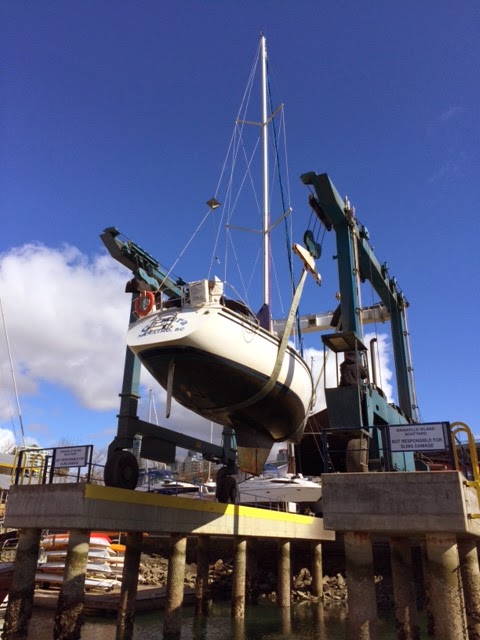
Hauling her out of the water

The guys at the Granville Island boatyard are really efficient and within minutes of being lifted out of the water, Ge'Mara was on jacks and her underside was being pressure washed.  To our surprise there was relatively little accumulation of sea life on the hull, thanks to the regular application of anti-fouling paint by the previous owner.  The keel seemed unharmed by rock we clipped but there were patches of rust on one side, perhaps where the rock had scraped the protective paint off.


Rust spots on the keel.  These will be ground
down and epoxy applied to exposed areas.

Our marine mechanic, Laurence Abro of Triton Pacific Marine Services, is supervising all of the work on the boat and performing important inspections.  After the keel, one of the key items we had for him to inspect was the rudder.  When we had the boat surveyed a year ago it was noted that one of the bushings was worn and may need to be replaced.  After removing the rudder Laurence confirmed this and wasted no time in having a new one fabricated by a local machine shop.

After the first day the hull had been polished to gleaming.  We were so pleased with how it looks that we engaged Trish, a local boat detailer, to detail and polish the topside, including oiling the long neglected teak rails.

Meanwhile the old decals on the transom have been removed, much to David's relief.  Due to some old and painful memories, the reference to Nanaimo on our boat irked him to no end.  Very shortly Erl the sign guy will be by to reapply the name and home port of Vancouver.  Contrary to what I've written in the intro to this blog, we will not be changing Ge'Mara's name.  After agonizing over the issue we mutually decided that while Ge'Mara wasn't our name, it has come to be the name by which we know her best.  She has treated us kindly this last year and so we have no wish to start fresh now.

Artist's mock-up of the new boat name and home port.
In addition to cleaning and repairs we have a couple of upgrades we've decided to make.  First, we are replacing the ancient VHF radio in her cabin.  A new radio is actually very inexpensive and will utilize DSC (Digital Selective Calling) technology, as referenced in an earlier post.  DSC utilizes the Global Positioning System to maintain a fix on the boat at all times.  In case of emergency we can push a button on the radio that will automatically send a distress signal to the Coast Guard with our exact position and identification of the boat.

Lastly and after much debate, we have decided to add an autopilot.  This is an expensive decision, adding several thousand dollars to the bill but well worth it in the end.  For my part it will enable me to safely begin single-handing the boat this summer while I am off work and have time on my hands.  For David it is an extra measure of safety while introducing his wife and family to sailing.

Exciting times as we prepare Ge'Mara for another year of fun on the water.

Saturday, March 15, 2014

A New Chapter

At the risk of sounding melodramatic, this coming week marks the end of an era in one part of my life and the start of a new chapter that will no-doubt feature even more fun on the water.  After 15 years I am leaving my job and taking a well earned break.  It's fun to contemplate all of the sailing possibilities that exist now that I have the time to explore them.  In preparation for this, David and I are getting the boat ship-shape.

This weekend we'll take Ge'Mara for the short ride from Coal Harbour to Granville Island where she'll be pulled out of the water put "on the hard" for some maintenance work.  One of the things we're really looking forward to doing is repainting the transom and changing her home port to Vancouver rather than the current Nanaimo.  The plan has always been to change her name to "Never Better" but we're scratching our heads at the moment on whether we want to go through with it now that the opportunity is here.  Looks like it will be a game-day decision.

The next big trip we have scheduled is a run to Princess Louisa Inlet (PLI).  This breathtakingly beautiful spot is about four days sail from Vancouver, located at the end of the much larger Jervis Inlet, the entrance to which is just East of Nelson Island.  PLI is a fjord with towering snow-capped mountains on both sides.  At the end of the inlet there is a large waterfall known as Chatterbox Falls.  It's a destination that is at the top of most boaters' wish list in the Pacific Northwest, sail and power alike.  With that in mind, David and I are very deliberately making the trip in the early spring to avoid the crowds and hopefully have the place largely to ourselves.

It promises to be a great year on the water.

Princess Louisa Inlet.
Voted "the most scenic natural anchorage in the world"

Tuesday, January 21, 2014

Happy Birthday Ge'Mara

This past weekend marked exactly one year since we sailed Ge'Mara home to Vancouver from Nanaimo.  It seemed fitting that we take her for a run.

After a 3-month respite from sailing David and I were ready for some time back on the boat. Our day trip to Snug Cove a few weeks back didn't really cut it so we used Ge'Mara's "birthday" as an excuse to head out a little further and drop the anchor for a night.  Even though we still weren't going very far I was interested to see how comfortable it would be in the near-freezing temperatures of mid-January.  We reflected that it was March last year before we spent the night at anchor so this seemed like a little bit of an adventure in the middle of an otherwise dull winter month.  Normally we rely on the electric heater at the dock in the dead of winter but for this trip we'd be limited to Ge'Mara's on-board diesel heater.

As usual Saturday morning we met at the local Safeway to provision.  We were determined to reign ourselves in this time and not go crazy on the food.  For the most part we succeeded...  But no matter what, you can't scrimp on the meat so we had the butcher cut us a couple of massive rib steaks for our main course.  We then considered breakfast for the next morning and briefly thought about skipping the bacon, given the size of the dinner we had planned.  We quickly dismissed that thought and picked up a pack of the extra thick, smokey kind.

After a brief delay caused by me forgetting my sleeping bag at home we left the marina.   Unfortunately once again there was no wind to speak of so we settled in for a long motor and talked.    Just like last time when we turned the corner around Pt. Atkinson we were met by the Howe Sound outflow and we raised the sails.  We had about half an hour of very pleasant sailing but once we turned out of the Sound towards Long Bay and Gambir Island, the wind died.

David at the helm on the way out
A while later we were comfortably anchored in Long Bay.  We surveyed the area and took note of the two other boats who were anchored nearby.  We stared at the long evening shadows forming over the water and the beauty of our surroundings, shivered and retreated to the warmth of the cabin.  It was 4:30pm.  Safely ensconced below, we poured ourselves a drink and chatted for a bit. At 5pm David asked if he should start the barbecue.  I gave him a pained look.  I could see the whole thing taking shape in his mind...  David has the ability to go to bed at an incredibly early hour and leave me sitting with a full glass of whisky and nobody to talk to.  Now he was trying to get dinner started early and I'm sure he was thinking if all went well he could crawl into his bunk at 7pm.  I was having none of it and suggested he crack another beer and relax.  We could start cooking at 6pm.  I put out the cheese and chorizo I bought for the occasion (we're not barbarians after all) and we snacked and drank for another hour.

Happy Hour - Beers and a Dark n' Stormy
We had decided to let the cabin heater run non-stop since before we left the dock and it was really quite comfortable down below.  Before long we had our sweaters off and were happy just in t-shirts.  I put on a sweater and went up on into the cockpit just long enough to grill the two slabs of meat and then we settled down to a huge dinner of steak, potatoes and onions, and salad.  It was a delicious meal but way, way too much food.  David wisely left half his steak to wrap up.  I demolished mine.

Beef.  It's what's for dinner
I looked at my watch after we'd enjoyed a scotch and somehow we'd made it to 8pm.  With the cabin positively toasty David collapsed contentedly into his v-berth for the night.  I was ready for this and had downloaded a movie onto my MacBook to occupy me for the rest of the evening.  It was Hunter S. Thompson's "The Rum Diary" and I crawled into my own cabin, with a tot of rum for good measure, and settled in to watch my movie.  I was asleep by 8:20pm.

As I crawled out of my little cabin the next morning, turned on the heat and put the coffee on I resolved once again to exercise a little restraint on these boat trips.  I'm the smartest guy in the world at 7am.  With the previous nights' sins still weighing on my mind (and stomach) we decided to skip the bacon at breakfast.  However I did cut up David's steak and fried it up with the leftover potatoes and 6 scrambled eggs.
Morning
I wish I had some fun sailing to report on the way home but it was not to be.  We got the sails up for about half an hour and other than that it was motoring all the way home.  I wanted to be back to watch the Seahawks game at 3:30 and we made it in plenty of time.  We agreed that Ge'Mara's heater was more than up to the task of keeping us warm in the dead of a Vancouver winter, so long as she had a bit of a head start.  This gives rise to all sorts of new winter sailing opportunities.  Can't wait.


Sunday, January 5, 2014

Back on the Water

As my blog posts will attest, Ge'Mara sat idle in her slip from mid-September until the new year.  David and I would occasionally stop by to say hello and ensure nothing had frozen or broken but other than that she sat unused.  After a long and eventful summer of cruising it was probably time for a break.  Work demanded our attention once again and fall storms swept in from the Pacific, further dampening any lingering enthusiasm for being on the water.  But now it is January - one year almost to the day since we purchased our lovely boat and sailed her home.  Almost on cue, we've both been feeling the itch once again to get back to the water.

It started with David's birthday in late December.  After celebrating in the usual way with family he declared that he would also like to mark the occasion by grilling some steaks on the boat.  At the time there was a prolonged winter storm blowing through, which in Vancouver means almost nonstop rain.  But that's what he wanted and I was sort of looking for an excuse to get back to the boat so steak it was.  It ended up being a great evening.  David and I hadn't spoken much given distractions with business travel, family and the holidays.  We enjoyed catching up over a rich California cabernet and a couple of succulent New York strips, followed by a nip or two from the bottle of 18 year old scotch I'd brought as a birthday gift.

The following week the skies cleared and with just the weekend between us and the return to work and routine we decided it was time to take Ge'Mara out for a run.  We decided a trip to Snug Cove on Bowen Island would be just the ticket, enticed by the fantastic bacon cheeseburger they serve up at Bowen Island Pub.

The forecast earlier in the week had been for 10 - 15 knot winds but when the day arrived winds were calm, other than a brisk outflow in Howe Sound.  I queried David first thing in the morning about the point of motoring all the way to Bowen but he wanted to press on and I'm thankful for that.

When I arrived before 10am David had already been there for some time and had started to prepare the boat.  I set about taking down the Christmas lights I had hastily put up for the benefit of those walking by on the seawall.  I had lifted the 120ft string of lights from the middle up to the top of the mast with the main halyard.  After releasing the halyard clutch, a light tug on the lights should pull it all down again.  Unfortunately when I tried it wouldn't budge.  I suspected this might be the case with the cold and the halyard not being used for a while.  I pulled a little harder on the string of lights and then - SNAP - they broke and part of the string came crashing down on top of me.  The rest of the lights remained aloft along with the halyard.  At this point I cursed, realizing that if the same thing happened with the other side of the string our halyard would be stuck at the top of the mast and nothing short of hauling someone to the top would retrieve it.  Until then there would be no sailing.

As I gingerly played with the remaining string, David inspected the lines and suggested that if I released the actual halyard rather than the mainsheet (which is what I had inadvertently released), things might go more smoothly.  Sheepishly I released the proper line and the lights and halyard pulled down smoothly.

A short while later we cranked the engine and despite the cold she started gamely without much protest.  Both David and I were feeling a little rusty with our pre-launch checklist so we paused an extra moment to make sure all was ready and then set off.  Sure enough there was no wind to speak of  and even though we had removed the mainsail cover there was no attempt to actually sail.

Heading out for the day.  Calm seas and no wind.

After a while we both realized that it was actually quite cold.  We were remembering last year's winter sails but on reflection, most of those took place in temps that were above 8 degrees Celsius.  Today it was hovering around 3.  When we rounded Pt. Atkinson and turned towards Bowen we felt the Howe Sound outflow in our faces and there was certainly enough wind to sail but by that point we were both too cold to care.  We motored on towards Snug Cove and resolved to put he sails up on the way home, once we had warmed up and filled our bellies.

As we approached the dock we had to stand off to allow the BC Ferry loaded with people and cars to depart for the mainland.  With a deafening blast of the ships "whistle" the ferry departed and as soon as we deemed him safely out of his slip I pulled in behind him and attempted to line the boat up to dock.  Big mistake.  The substantial thrust from the departing ferry immediately started pushing us broadside into the dock and I was forced to quickly turn into it and gun the engine just to keep from being slammed into another boat.  Even after the ferry was well away and I lined up for a second attempt I had to again maneuver away due to the lingering effects of the ferry. When the artificial current had finally subsided and I brought us close to the dock we looked up and saw a sign that said in bright red letters "BEWARE OF FERRY WASH."

The dock was covered in frost and we gingerly stepped off and tied up, wary of how slippery frosty docks can get.  I had just about brained myself and taken a swim earlier in the day on a slippery dock at Coal Harbour.  We walked briskly up the hill to the pub, trying to put feeling back into our frozen toes but it wasn't until we had been seated at our table and eating before we felt completely warm.

On our return to the boat we saw two guys loading what looked like fire logs onto their sailboat and we realized that they were wintering on their boat and had a furnace inside for warmth.  David commented that their boat looked like it hadn't moved for some time.  What a contrast this was from the hour-by-hour competition for dock space in the summer.  Sailing in the winter is truly different experience.  It may be cold but it's much more peaceful somehow.

The dock at Snug Cove was frosty

As we left Snug Cove I expected to feel the outflow breeze again and contemplated the effort of raising the mainsail.  David was at the helm so I knew it would be me doing the work this time.  I should have been looking forward to it but the chill had sapped my enthusiasm for the short sail to Pt. Atkinson and I was secretly relieved when we discovered that the outflow wind had died.  We settled in to motoring home.  We had done most of our catching up so we amused ourselves watching the massive tankers and container ships steaming out from under the Lions Gate bridge towards some far off destination.

A while later we approached Coal Harbour marina and it was David's turn to bring the boat in.  Out of an abundance of caution, having had a few months off, David slipped the boat into neutral about 100 meters from the slip.  It is customary to do this when approaching so as not to have too much momentum when approaching the dock but this was a little further out than normal.  I waited on deck with the bow line as we crept slowly towards the dock.  The GPS registered zero knots.  I slept for a little bit I think.  But finally we made the turn into the slip and David was rewarded for his patience by stepping lightly off the boat and tying the stern, so little movement was left in the boat.  We joked that it was the slowest docking ever for our boat but in reality, with an icy dock and rusty docking skills, it was a prudent decision.

We buttoned up the boat and paused for 5 minutes to enjoy a wee dram of Glen Livet to toast the day, as is our custom.  It was good to be back on the boat and to revive both her and ourselves from our winter doldrums.