Thursday, June 5, 2014

Single Handing

A Primer on Single Handing:
When I first got involved in sailing I was struck by how many terms we use in everyday life that have nautical origins.  For example, if a shopkeeper says he is "shorthanded", he's actually using a sailing term that refers to having less than the optimal number of crew on a the boat.  (Imagine an America's Cup boat being operated by two or three people).  Sailboats usually require multiple people to handle a variety of tasks, often simultaneously.  Someone needs to steer the boat,  handle the jib sheets, attend to the trim of the mainsail, and so on. These jobs can often be performed consecutively rather than concurrently but the process will be less efficient.

Likewise, people use the term "singlehanded" to describe accomplishing a task by one's self.  This term is actually derived from the operation of a sailboat with only one person on board.  This can be tricky on any boat but particularly on a sailboat which traditionally requires at least two operators; one person at the helm and one person working the lines and sail trim.  Docking and anchoring of course, is another matter.

In some ways, the concept of single handing seems at odds with the normal standards of sailing.  Avid mariners tend to be a meticulous lot with scrupulous concern for detail.  There are procedures and processes for everything, be it coiling ropes, trimming sails or stowing gear, and anyone taking shortcuts tends to be looked down upon.  With this in mind it would seem counter-intuitive for a sailor to attempt to manage his vessel by himself when clearly it was designed for multiple hands.  But as it turns out, the fastidious nature of the sailor can be overcome by an even more compelling need; freedom - and possibly solitude.  Indeed, the concept of freedom and release from everyday tedium has been connected with "sailing away into the sunset" for as long as anyone can remember.  And so it is that sailors will find ways to manage their vessels by themselves in order to control their own destiny and find their freedom, regardless of the added risk or inefficiency.

Single-handing has a long and rich tradition.  Possibly the most famous single-handed journey ever documented is Joshua Slocum's classic account of his solo circumnavigation entitled "Sailing Alone Around the World."  Slocum certainly wasn't the first to Single-hand but he may have done more to promote the practice than any other single person in history.


Today single-handing is a common practice for experienced sailors, the more eclectic of whom compete in round the world races that have generated some interesting stories of their own.  But perhaps one example best illustrates the ethos of the single handed sailor, albeit taken to the extreme.  In 1968 French sailor Bernard Moitessier participated in a round-the-world, non-stop solo sailing race.  He was a man of the sea and in spite of innumerable storms and setbacks, he stood an excellent chance of winning the race.  However Moitessier had left many personal demons behind in Europe, and the closer he came to completing the race, the more angst-ridden he became.  Finally, as he was poised to finish and possibly win, he came along side a passing freighter, inserted a note into an empty 35mm film canister and sent it up via slingshot to the crew to be forwarded to the race sponsors in London.  In it he announced his resignation from the race "...because I am happy at sea and perhaps to save my soul."  He went on to sail to Tahiti.

************

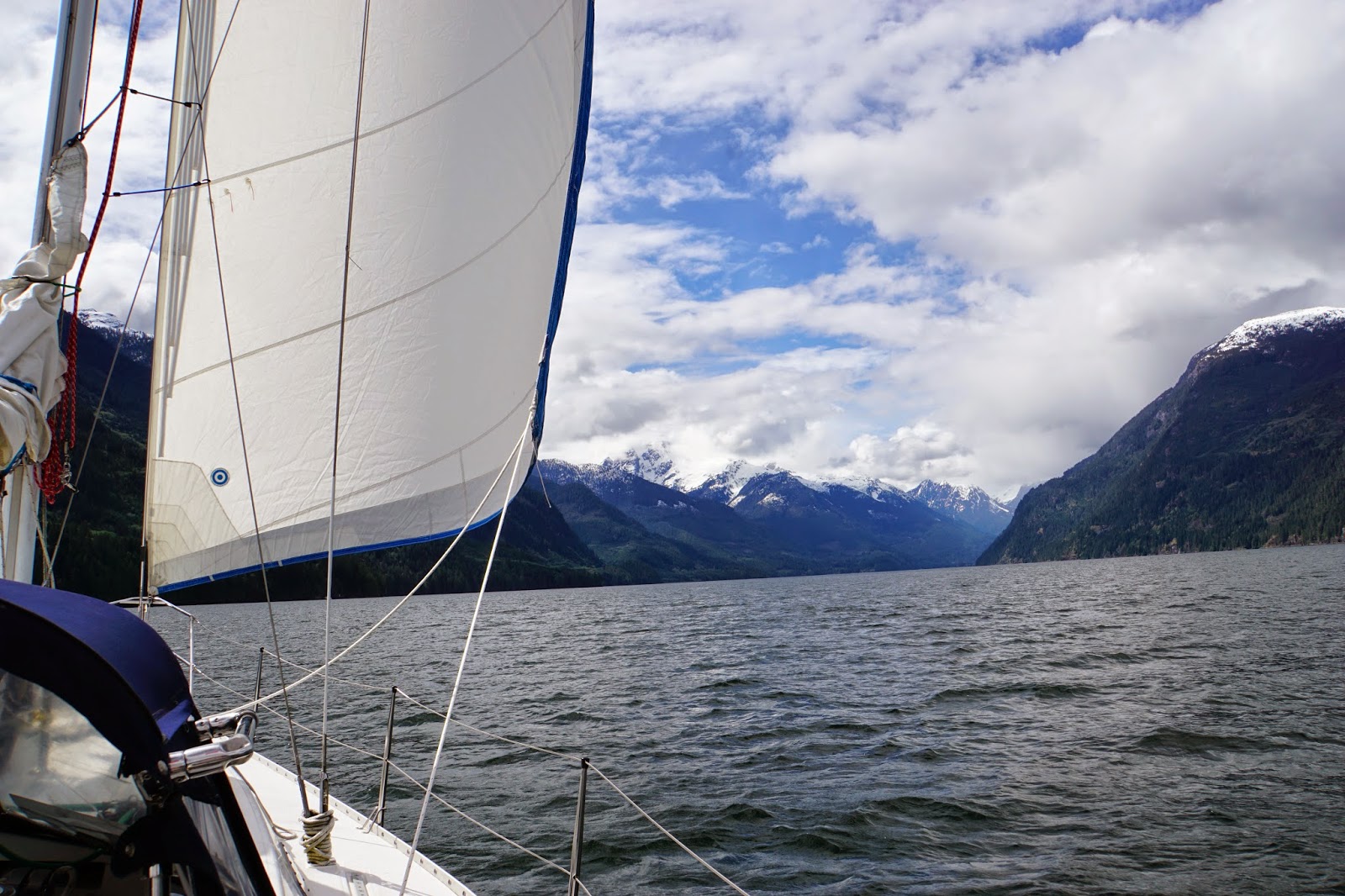
As I wrote earlier this spring, one of the enhancements we made to the boat was the addition of an autopilot.  We had toyed with this for nearly a year but when I found out I was being "cast off" by my employer along with a summer sailing allowance, the autopilot moved abruptly into the "must-have" column. (In addition to steering the boat during long periods of motoring, an autopilot can take the place of the "2nd man" at the helm during critical moments such as raising and lowering the sails or tacking.  In this way, it allows one person to manage all aspects of a sailboat's operation alone.)  After seeing how well it worked on our sail to Princess Louisa Inlet I knew then for certain that I wanted to head out on my own.

The weather after the PLI trip was maddeningly uncooperative and I waited impatiently for the chance to head out.  Fortunately after a few weeks the forecast took a positive turn.  The coming weekend looked to be a beauty and I had planned a solo trip across the Strait of Georgia and into the Gulf Islands.  However as my planned departure date approached the wind forecast was cause for concern.  Strong wind warnings were issued for the entire weekend, with winds reaching 25kts at certain times of the day.  This kind of wind is not impossible for Ge'Mara to sail in but David and I were still getting used to those conditions together so it seemed foolhardy to take them on myself.  The morning of my planned departure I sat undecided in my condo and looked at the boats bobbing in False Creek, the water reflecting the brilliant sunlight and blue sky.  How hard could it be?

I called an experienced sailing friend and asked his advice.  Knowing my skill level he suggested I would be fine, with the obvious caveat that I reef the main.  I still wasn't completely comfortable but my friend had removed the worst of my reservations so I set aside my remaining fears and prepared to leave.  I had to cast off by 1pm in order to make slack tide at Porlier Pass later that evening so I had a busy morning packing and provisioning the boat.

In the taxi on the way to the marina I got a text from David.  He was in his own taxi from the airport on his way to the office, having just returned from a business trip to Ohio.  He asked what headsail was up and I told him it was the 135.  We also own a 110 genoa which would be more suitable for the windy conditions.  Good friend that he is, he came straight to the boat in his work clothes and helped me change the headsail (on our boat this is a two-man job).

A while later I was motoring out of English Bay towards the Point Grey bell buoy.  It was a long uncomfortable slog against wind, waves and tide that offered plenty of time for reflection.  Why was I doing this anyway?  What was so important that was driving me to sail away by myself in uncomfortable conditions?  A quote came to mind that I had read in one of my favourite sailing books*.

"He who starts on a ride of two or three thousand miles may experience, at the moment of departure, a variety of emotions.  He may feel excited, sentimental, anxious, carefree, heroic, roistering, picaresque, introspective, or practically anything else; but above all he will feel like a fool."
Peter Flemming


The journey to the mouth of Porlier Pass is 20 nautical miles.  I planned to anchor 2 miles the other side of the pass.  Be that as it may, the quote still resonated in a way that it didn't when I first read it.

Eventually I passed Point Grey and it was time to sail.  I raised my already reefed main and unfurled my genoa.   Immediately the boat heeled well over and I scrambled to trim the sails to the best of my ability.  This accomplished, I took over control from the autopilot and focused on holding my course of 196 degrees toward Porlier Pass.  The waves were up after hours of sustained winds and I took them on the beam.  This was a less than comfortable sensation given how far I was already heeled over.

After a while I set the autopilot again and sat high up on the windward side of the boat, for once in my life wishing I had more than my 235lbs to serve as rail meat.  I called a close friend and checked in.  She asked about the conditions.  I told her a bit but the tone of my voice told the full story.

"Maybe you should turn around."

"Um, yeah maybe.  I'll go a bit longer and see."

The truth was, the boat was reasonably well balanced and I wasn't sure what I feared most, continuing out into the strait or trying to turn the boat around amid the wind and waves.

"I think I'll be ok.  I'll keep you posted."

"Ok.  Be careful."

I spent the next hour placating myself with indecision.  Even though I was sailing at 7 knots further and further from land, somehow by giving myself the option to turn around it made things easier.  Point Grey was well behind me now but off in the distance to port was the control tower of Vancouver airport and still later, the loading cranes of Roberts Bank terminal stood as a reassuring landmark.

At around the halfway point across the strait I realized that I felt more comfortable and that things were going to be ok.  It seemed as though the wind had calmed slightly or maybe the seas were down a bit, or maybe I was just growing used to the conditions.  In any case, as the mouth of Porlier Pass came into focus I had a growing sense of relief, well being and ultimately accomplishment.  This trip was going to happen and I was going to live to tell about it.  As if there was ever any doubt.  As with most fears, once confronted they shrink to something closer to their actual size.  I looked off to starboard and saw, incredibly, a small sailing skiff less than half my size, also heading for Porlier.  "Never Mind," I thought.  That was his accomplishment.  I was still revelling in mine.

I had arrived at Porlier a full hour early due to my speedy crossing and I hesitated to fight the still-flooding current.  However a few moments later I saw the little skiff heading fearlessly in.  That, and the tug towing two barges of wood chips bearing down behind me was sufficient motivation to proceed.  Before long I was through and motoring into Clam Bay on the Northeast side of Thetis Island.  I doused the sails, motored in and dropped the anchor at a respectful distance from the nearest sailboat that had already taken up residence.  Satisfied my anchor was well set, I cut the engine and stood looking out at the bay.  I'm not sure why, but standing there in the cockpit by myself I was trying hard to suppress a grin.  Not for the first time since buying Ge'Mara I felt like a kid again.

************

By tradition I would normally make myself a Dark and Stormy at this point but I had declared a moratorium after getting a little carried away earlier in the week.  I did, however, open a bottle of wine and light the barbecue.  Shortly after I slapped an impossibly large New York Strip on the grill and went below to make a salad.  It was lost on me that eating that entire steak was far more stupid than venturing out solo into a brisk wind.  I had a fitful sleep and an upset stomach.


The next morning was calm and beautiful as it always is at that time of the day.  I did my best to relax and enjoy the peace and solitude of being at anchor alone in the sunshine.  It occurred to me that I should read a book.  But eventually my itchy feet got the best of me and I weighed anchor and motored away.


The plan for today was to head south to Ganges Harbour on Saltspring Island.  I had been there before by BC Ferry but never on Ge'Mara so it seemed like as good a destination as any.  Also, I had made contact with the author of a book that I've already mentioned, one that I have enjoyed for many years.  He lives on Saltspring and he and I had made tentative plans to meet for a beer.  (I was surprised and flattered that he had agreed to do so).  In the end we couldn't make it work this particular weekend but I decided to press ahead with the plan to visit Ganges regardless.

The Northwest wind was still blowing but here inside the Gulf Islands it was muted.  No matter, I was now heading almost directly downwind so I spent a peaceful few hours, carried South by both wind and tide at 7 knots toward Ganges.  During the few languorous hours on this run I listened to CBC on my satellite radio and casually scanned the local charts along with a cruising guide that described all of the local marinas and anchorages.  I was sailing with Galiano Island to port and Saltspring Island to starboard.  I noticed on the chart there was a large well protected bay on Galiano called Montague Harbour.  The cruising guide spoke well of the place so I decided to check in there before committing to Ganges.


Montague Harbour, it turns out, is one of the most beautiful and sought after cruising destination in the Gulf Islands.  It is very well protected, to the extent that once anchored or moored it is impossible to see where you entered.  The depth in the harbour is such that there is room for a great many boats to anchor without seeming overly crowded.  At the north end is a marine park with numerous mooring buoys for public use.  At the south end is Montague Harbour Marina.  I briefly considered the mooring buoys but seeing as I hadn't brought the dinghy with me I opted to check in with the marina so I could stretch my legs.

I explained to the gal in the marina on the VHF that I was single handing for the first time and she assured me that someone would be there to meet me.  She assigned me a slip that thankfully could be approached from downwind.  The fellow who assisted me was effusive in his praise for my docking and it I muttered something about being lucky.  When I finished tying up he stuck his hand out.  "I'm Dan.  I just bought this place two weeks ago."

************

With the boat secured and systems shut down I walked up to the marina office to pay for my slip and look around.  The lady who took care of me mentioned there is a bus that takes people to the main pub, elsewhere on the island.  "It comes at 5 minutes before every hour, starting at 5 o'clock" she said.  I had heard of this bus before and I found out later it is somewhat legendary among boaters, having been in operation for the last 25 years or so.


I went back to the boat and along the way chatted with Dan.  We talked about his big step to purchase the marina and revitalize it.  He pointed out his Mom and Dad who were helping him for a few days until things were under control and the local kids were available to work for the summer. "You wait," he said.  "This place is going to be awesome."  I thought it was pretty awesome already and told him so.  There were only a few transient boats in the marina this weekend but Dan assured me as the season progressed it would be packed.  I felt oddly privileged to have visited here and met Dan so early in his plans and I found myself rooting for his success.  Over the time I was there I was made to feel like a friend and this congeniality added a lot to the overall experience of the trip.


I have always made fun of David for napping in the afternoon but by 3pm I was feeling tired.  It seemed oddly indulgent but I took a nap on the settee.  I never do this.  As I listened to the sounds of the marina outside the cabin I dozed off feeling more relaxed than I could remember being in a long time.

When I woke up I decided to shower and catch the bus to the pub.  The marina had no showers, owing they said, to the lack of fresh water on the island.  I used the shower on the boat which was more than adequate, particularly with me being the only one aboard and therefore not sharing my water supply with anyone else.  I shaved and felt refreshed for having gone to the effort.

I walked up the road to the bus stop and two guys were already waiting there.  After a time we struck up a conversation and I found out they were anchored offshore on a beautiful 50ft wooden sailboat.  We asked each other polite questions about each other's boats.  All three of us stood with our arms tightly crossed.

Eventually an old yellow school bus came rolling to a stop near us and we stepped aboard.  The Beatles song Yellow Submarine was blasting on the stereo.  The driver greeted us enthusiastically and roared off to his next stop.  Arrayed above him were cymbals, drums, cowbells and various other devices he used as crude instruments.  A tambourine was mounted on his steering wheel.  Turning the music up, he proceeded to bang away on his instruments with unreserved enthusiasm, one hand on the steering wheel,  the other hand flailing with a drumstick.  Shortly he reached down to his left and produced another tambourine which he promptly passed to me.  "Going to put you to work!" he grinned.  I banged away for a while in time with the music, feeling vaguely stupid.  I could see the sympathetic looks on the faces of the other two guys and a moment later I passed my instrument to the nearest one, glad to be rid of it.  Immediately another instrument was thrust into my hands.


We stopped again and there was a dozen or so older guys waiting to embark.  As they stepped on, each was given an instrument of some sort.  Some were clearly home-made, others were perhaps high school band rejects.  Soon the whole bus was banging away to the backdrop of "I Found My Thrills" blasting on the stereo.  Beside me sat a Hemingway look-alike who sullenly refused to participate.  I felt sorry for him and glad that I had overcome my own self consciousness.  I shook my maraca a little harder.  Look at me, I thought.  I knew I'd have some fun but I hadn't expected this.

Later that evening I returned to the marina with my new friends and invited them aboard Ge'Mara for a scotch.  We chatted for quite a while about all things sailing.  They were gracious in their praise for Ge'Mara, considering how much nicer I knew their boat to be.  When they left I put some marinated beef ribs on the barbecue and poured the remaining red wine.  This was turning out better than I expected.

************

The next day I had a decision to make.  The strong winds that were forecast to dominate the week were going to abate for a while and I had a window to head back across the strait without any drama.  In fact I might need to motor at times.  As much as I'd enjoyed my sense of accomplishment at crossing a few days earlier in big wind, the thought of not doing that again was attractive.  On the other hand, I was really starting to relax here and I didn't relish the thought of cutting my trip short.

As I considered this dilemma my friends from the big boat came motoring past in their dinghy and waving.  They pointed to shore and I remembered they had plans to rent scooters from the Marina to explore the island this morning.  On a whim I decided to join them.

Even though it was Sunday and prime time for this kind of thing, the scooter rental people were nowhere to be found.  We called the cell number posted on the sign and 20 minutes later a retired man and his wife drove up in a pickup truck and introduced themselves.  We took care of the paperwork for the rental, listened to the requisite briefing on the safe operation of the scooters and we were set free.  In my haste I hadn't locked up the boat so I told my friends to go ahead.  A short while later I donned my ridiculous looking helmet and fired up my scooter.

I have a friend who can't ride a bicycle without grinning from ear to ear.  This amuses me to no end and I've always envied the joy she feels in such a simple thing.  Now, as I accelerated down the smooth asphalt road and leaned into the corners, I was doing exactly the same thing.

That afternoon on the scooter was pure, unadulterated pleasure.  Sure, it wasn't a Harley, or even the 500 cc street bike I rode as a teenager.  But it was a blast nonetheless.  And on the mostly deserted pastoral roads of Galiano, who the hell cared anyway?  I stopped at the local grocery store and to my surprise found good ginger beer.  I bought a few bottles and put them under the seat, already anticipating the cold Dark and Stormy I would have later that day.  I came across a little book store, the kind that seems to exist on every one of the Gulf Islands.  I thumbed through the new and used books and walked out with a copy of H.G. Wells' The Strange Island of Dr. Moreau.  I'd always wanted to read that book.  It was brand new but somehow I wished I'd have found a used copy.  I put it under the seat with the ginger beer and carried on.


I found my way to the Galiano Inn and enjoyed a succulent wood-fired pizza and drank good pale ale while watching the ferries make their way through Active Pass.  I flirted with a lady several years my senior who was drinking champagne and chatting me up.  I was full of a sense of well being.

With a full stomach I continued my tour of the island, stopping occasionally to enjoy a lookout or walk to the ocean.  I shook my head at the thought that I'd lived in BC for over 25 years but I hadn't taken the time to explore the islands like this until now.  It was a fine afternoon.


************

The next morning it truly was time to go.  I needed to be back in Vancouver for a Tuesday morning meeting with a prospective employer.  The marine forecast was once again full of red ink, indicating a strong wind warning.  I would be paying for my fun the day before with fun of a different kind today.

I filled my tank with diesel, said my goodbyes to Dan and family and motored away from the dock.  I had calculated a 2 hour motor north into the wind to get to Porlier Pass, whereupon I would have a brisk sail home across the strait.  This in fact is exactly what happened.  In a little over two hours I was transiting Porlier, just in front of another sailboat.  As I exited the pass I raised my mainsail, this time triple reefed in an abundance of caution.  So far so good.  I unfurled the Genoa and I was off.  To my quiet pleasure the sailboat behind me seemed to be having trouble finding a suitable point of sail and I was putting distance between us by the minute.  Eventually though, she found her way and began to gain on me.

For a while we sailed in parallel across the strait and all was good.  My triple reef was probably more than necessary however and eventually the other boat pulled ahead.  As the distance between us grew, I grew frustrated and decided to turn into the wind and release the reef.  The plan was to change to a standard double reef but in the waves on the open ocean this proved more challenging than I and anticipated.  In the end I just raised the full main and worked on getting back on course.  By now the other boat had put significant distance between us.  Frustrated as I was, I stopped worrying about our mock race and settled in to enjoying the reminder of my sail across the strait.  Besides, now I was slightly over-canvassed and was more concerned about keeping the boat under control.

A while later my phone chimed.  I had received a text from David offering to meet me at the slip.  I readily accepted and put my mind to making as good time as possible.  My hope was that I would turn downwind into English Bay and use my full main and genoa for a top speed run for home.  Unfortunately, once past Point Grey the wind became fickle and in frustration I eventually doused the sails entirely and motored home.


Back at the slip, David and I toasted my safe return, he with his strong German beer and me with my Dark and Stormy.  He had been stuck in the office and was envious of my trip but happy for me and proud of my small accomplishment.  As I related my adventure to him over drinks I couldn't help but think that for all the pleasures of solo sailing, it was good to enjoy the company of a friend.

***

*The Water in Between by Kevin Patterson. Published by Randomhouse

Sunday, May 18, 2014

Sailing to Princess Louisa Inlet - Part V: The Trip Home

Note:  For earlier entries in this trip log, scroll down or click on an entry at the left of this page.

Some of the finest moments I've had on the water have been those spent at first light up top with a cup of coffee.  For a few precious moments, all is still, the water is calm and all the pleasures of nature seem distilled to this.  With that said, this morning may have been my most memorable yet.  The day dawned without a breath of wind and the water truly did appear as glass, mirroring almost perfectly the surrounding scenery.


After a short while enjoying these moments we shook ourselves from our revery and made preparations for departure.  We had thought for a while of staying here another day but the plan called for us to head for home and David had no way to contact his wife and advise her of a change.  We started the engine, untied from our mooring buoy and motored away.

As we exited through Malibu Rapids we expected to be greeted by a fresh breeze in Jervis Inlet.  Surprisingly it was every bit as still, the water just as perfect as inside PLI.  The result was a similar view as we woke up to but on a much grander scale.  Deep blue sky, vivid white snow caps and deep green forest were all reflected perfectly in the water around us, disturbed only by the oily ripples of our small wake.  Heaven x 2.  These few moments spent motoring at half speed into the stillness, leaving Princess Louisa behind us, will live in my memory for a very long time.

Click to enlarge


We turned the corner past Deserted Bay and at last felt a brisk breeze in our faces.  We briefly experimented with sailing but realized it would require an endless number of tacks across the inlet to make any forward progress.  So we set the autopilot and settled into the long motor back down Jervis Inlet.

Two thirds of the way down Jervis is Vancouver Bay.  This was another place we had scouted as a possible anchorage if we needed it.  We were in no particular hurry so we decided to explore the bay, drop the hook and have lunch.  When we turned in we noticed a strong breeze was blowing directly into the bay.  We were told that the only possible anchorage lies at the point where the Vancouver River empties into the bay so we headed for this spot, watching the depth gauge expectantly for shallow water.  To our dismay, it was only at the last minute the the bottom rose up to a suitable anchoring depth and at that point it was rising quickly.  We wrenched the boat around into the wind and, struggling to keep station in a brisk wind and incoming waves dropped the anchor.

Vancouver Bay on the chart. 

There is an old mariner's rule that says "beware of a lee shore."  A lee shore refers to a boat being blown towards shore by the wind.  Sailors rightly feared this because in the days before engines, if a skipper ventured too close to a lee shore he would eventually reach a point where it would be impossible to sail across the wind and away from land.  At this point all that was left was to wait until the boat went up on the rocks.  This isn't a problem in modern times when you have an engine but if, heaven forbid, the engine quits, you're pretty much in the soup.

And so it was that we finally got the anchor set but had a brief and nervous lunch on the hook, one of us keeping an eye on our depth at all times.  Even during our short 10 minute break Ge'Mara dragged her anchor several more feet towards shore.  We motored away from there making a note that Vancouver Bay held no suitable anchorage.

As we approached the mouth of Jervis Inlet we realized that we had made a mistake in our tide calculations and we couldn't turn up Sechelt Inlet to head for the Backeddy for another 2 hours.  We had planned to stay another night there and use the TV in the marina to watch the Montreal/Boston hockey game.  Neither of us had any interest in bobbing around and exploring waters that we had already seen so we made a quick change of plans and headed directly into Agamemnon Channel towards our new destination, Pender Harbour.  It was a long afternoon of motoring with nothing much to report except the moment when I just about ran us aground because I was at the helm and fiddling with my phone.  Other than that, we listened to the hockey game on the XM satellite radio and stayed below the dodger and out of the chilly headwind that had been building all day.

Around 5pm we had left the channel and turned the corner into Pender Harbour.  We were now happy for this change of plan because neither of us had been here before so it would be an unplanned new experience.  Pender Harbour is actually a collection of cozy little bays, many of which have marinas and other boater facilities.  However we quickly realized that many of them were closed for the season or at least offered minimal amenities.  Ultimately we ended up at Madiera Park Marina at the government dock.  This is a working dock and it was mostly lined with fishing boats preparing their traps for spot prawn season which was to start the very next day.


The fishermen at Madeira Cove were preparing for Spot Prawn season


Both David and I had been fighting a cold on this trip so we headed into town in search of a drug store and a place to eat.  Unfortunately everything was closed so we schlepped back to the boat, had a drink, ate from our dwindling provisions and went to sleep.  

The next morning we walked back into town and in our enthusiasm purchased way too much food and cold meds for our needs.  Back at the boat we learned that Environment Canada issued a strong wind warning, calling for winds up to 25kts.  We had decided that rather than simply beating down the coast towards home into the wind we would tack across the strait to Namaimo and visit a mutual friend.  We were both a little nervous about this given the forecast but we set ourselves to the task of changing to our smallest genoa, a 110.  We also triple reefed the main.  With these things done we had shortened sail as much as was possible on our boat with our current inventory of cloth.

After stopping in Hospital Bay for fuel we headed out of Pender Harbour.  We had plotted a course that would take us just past the southern tip of Texada Island and directly across the strait to Nanaimo.  When it came time to raise the sails, David questioned the wisdom of doing so.  Under power the boat was burying her bow repeatedly in growing waves and the wind was even fresher than we had imagined.  After some debate we decided that it would be stupid to have gone to all the trouble to shorten sail and not even try in the end.  So we raised the sails and off we went.  For a while we were healed over a little more than was comfortable but soon I was able to balance the boat and find a point of sail that was as high into the wind as we could manage.  Unfortunately we could not make it past the southern tip of Texada so we tacked and found ourselves headed almost directly for Smugglers Cove.  We had a brief debate and in the end decided to forgo crossing the strait and instead spend the evening back in Smugglers.  After an hour or so of exhilarating sailing that's exactly what we did.


The next morning I woke up feeling refreshed but David didn't.  He was really feeling the effects of his cold.  After breakfast he announced that he would be just as happy spending the day in the shelter of Smugglers Cove sleeping than pounding against the southeaster that had been building since last night.  I wasn't a huge fan of this idea but relented and let him sleep the morning away while I did some exploring ashore.  I returned around lunch time to find David up and moving around so I decided I'd make a hot lunch and then pitch the idea of proceeding as far south as Gibsons.  I made two packs of Kraft Dinner and we scarfed it down like kids in the comfortable warmth of the cabin.  Thus restored, David announced he was up for the run to Gibsons, so we cleaned up and departed.

We noticed as soon as we were heading south in Welcome Passage that we weren't going to make as much speed as we'd hoped.  Past Merry Island and into the more open water the wind and seas began to build and it was clear we were in for a long, pounding run south.  At one point near the Trail Islands we passed a Canadian Coast Guard hovercraft and two military boats all seemingly working in cooperation.  Later we heard on the radio that a kite boarder had been swept out to sea and was in need of assistance.  It seemed like a lot of hardware to rescue one person but as we passed one of the military boats we saw them raising a dinghy with people inside off the water.  All's well that ends well.

We continued past the Trail Islands and past Davis Bay to Pt. Staleshen.  Once around the point the wind blew even more fiercely and the seas were higher yet.  We had been steadily losing headway in the growing seas and now we were motoring at full throttle but only making 2kts.  It was going to be much longer than anticipated to get to Gibsons.  I listened to our little Yanmar roaring gamely at full throttle and thought about the two instances where she had quit on me due to a fuel line blockage.  If that were to happen now we would be immediately blown north and would be in a fairly serious situation.  I consulted our charts and guide books for alternatives.  I read about a small private marina in the area, situated behind its own breakwater.  Looking up I saw it directly to port.  David and I debated the diversion, part of us not wanting to admit defeat but as we saw our speed intermittently dip below 2kts we decided it was the right thing to do.

Wind, seas and tide were all working against us.

We turned to port and headed for a small private
marina, visible at the centre of this picture.

We turned around and headed for the breakwater, noting that the entrance the marina was quite narrow.  Although we were headed straight for it we were also being pushed sideways by the wind and waves.  I once watched my friend land a small airplane in a crosswind.   Mimicking him I crabbed Ge'Mara towards the entrance, turning her bow into the entrance at the very last minute.  We motored cautiously into the small marina in barely 6ft of depth and waited for someone to express annoyance at our intrusion.  Instead, the marina was deserted.  The calm behind the breakwater was a huge relief and as we proceeded further in we saw a stretch of dock right at the front that would easily accommodate Ge'Mara.  At the head of the dock was a sign that said "Emergency Use Only."  Apparently we weren't the first to encounter this kind of situation.


Pt. Stalashen Marina - any old port in a storm!


After tying up I explored the marina to see if there was someone to pay and/or make arrangements with but there was no one to be found.  I ventured out of the development and came to a street with a strip mall with, among other stores, an IGA and a take-out pizza joint.  I went back to the boat and David and I quickly agreed that a hot pizza would be just the ticket.  We had cell service here so we found the number of the pizza joint and before long we were scarfing pepperoni pizza and beer, our little adventure quickly fading into memory.

Ge'Mara tied up in Pt. Stalashen Marina

The next morning we knew we would have a narrow window of relative calm before the southeaster picked up again and gave us similar grief.  We untied and left our little safe harbour as quickly as possible, grateful for the role it played in our trip.  Turning south once again, we motored uneventfully back home.  The wind and seas did pick up again but before long we were safely in English Bay, whereupon the sun came out from behind the clouds and things started warming up.

A short while later we were tied up in our slip.  Our scotch and rum supplies had been depleted across the trip so we contented ourselves with toasting a fantastic trip over a cold beer.  It was one to remember.

Sailing to Princess Louisa Inlet - Part IV: Relax and Explore

Note:  For earlier entries in this trip log, scroll down or click on an entry at the left of this page.

We awoke in Princess Louisa to our own little world.  Already boxed in on three sides by formidable mountains, our anchorage was now blanketed by low cloud.  It had the effect of transforming a soaring and expansive environment into a closed and cozy one.  Some might find this confining or even claustrophobic.  To me it was reassuring.

Gradually our little seven-boat community began to wake up.  People with steaming mugs of coffee began to walk the length of the dock, hair still tussled and eyes sleepy.  We chatted and speculated about the day's weather.  Most were happy to accept the dense cloud - it only enhanced the feeling of being apart from everything else - a feeling that boaters of all strips inevitably crave.


Eventually though, the sun began to burn away our canopy of cloud and in places it would peek in and illuminate the dock  and surrounding area as though it was a stage in an otherwise darkened theatre.  It was truly some of the most surreal natural light I have ever seen and it continued to evolve as we sat and chatted.  Soon the direct sunlight began drawing steam from the moist dock and it rose in etherial wisps as we talked.


Eventually we made breakfast and once we were done we set out to explore.  There is a rugged trail that leads from Chatterbox falls up the steep mountainside to an old trappers cabin.  David and I set out with our day-hikers looking forward to some exercise.  Before long we came to a sign that warned of treacherous conditions on the trail, advising all but the most experienced hikers to stay away.  Normally neither of us would be deterred by this but a few more steps validated what the sign had warned:  The trail immediately turned into a scramble over steep rocks for as far as the eye could see.  It had been raining off and on for days and the rock looked slick and moss covered in places.  We promised ourselves we would follow this trail - just not today.

Back at the boat I occupied myself by rowing out in the dinghy to explore and take pictures from a different vantage point.  I glided into the mist of Chatterbox Falls and played with the settings on my new camera, most of which remain a complete mystery to me.  I took pictures of Ge'Mara from the water and then rowed over to one of the waterfalls that fell from the mountainside.  I later learned that in Princess Louisa one should never approach a waterfall that has a dinghy lingering beneath it as the occupants are liable to be naked and taking advantage of a fridgid freshwater shower.


On my return to the dock, David had the barbecue going to make burgers for lunch.  With that done, we decided to move to a different part of the park about half way between the entrance at Malibu Rapids and where we were.  BC parks had installed some mooring buoys next to MacDonald Island so we thought we would spend the next night there rather than at a dock with boat neighbours.  We motored slowly over and before long we had tied to a mooring buoy and were enjoying our new, even more secluded environment.  I had to laugh at David, as he struggled much more with the mooring buoy this time in absolutely perfect conditions than he had on his first attempt over a year ago in Plumper Cove - in driving rain and high winds.

The nearby terrain was not nearly as steep as it was near Chatterbox and there was an unoccupied summer camp on the shore so we opted to row over in the dinghy and explore.  We walked around the well-kept camp buildings and commented that this would be a wonderful summer camp for anyone.  The tide was low and exposed huge beds of beach oysters.  David pointed out the interesting looking birds with long orange beaks called oyster catchers.  We also tromped through the bush, following a dried creek bed for a time.  Everywhere we went we saw reasonably fresh animal droppings and we speculated what kind of animal it might be.  I looked around and fancied that somewhere that animal was watching us from a distance.


We figured out where all the animal droppings were coming from

Oyster Catchers

Back on the boat we opened a bottle of wine and got the barbecue started.  As we chatted, David suddenly pointed to shore and we both had the answer to our earlier question.  There, lumbering around foraging was a sizeable black bear.  By this time we had burned through our first bottle of wine and were on to number two.  Thus emboldened, I got in the dinghy with my camera and rowed towards shore, hopeful of a better photo of the bear.  Perhaps fortunately, the bear wanted no part of this and disappeared into the forest before I could get close.  As a consolation prize I got a decent shot of a pair of oyster catchers.

Saturday, May 17, 2014

Sailing to Princess Louisa Inlet - Part III: The Arrival

Note:  For parts one and two of this trip log scroll down or click on the link you want to the left of this page.  A 30 minute HD video summary of the trip is below:


I awoke the next morning to the sounds of David going through the morning routine of putting coffee on and turning on the diesel heater to take the chill off the cabin.  Normally he waits for me to crawl out of my bunk and do this but due to the excesses of the previous night I was slow to wake up.  A bacon and egg breakfast seemed like a good idea but I couldn't contemplate such a complex task for a little while.  I sat in the cockpit with a cup of hot coffee and a bottle of water and watched the current race by the dock.

The dock at the Backeddy Marina, near Egmont

There were signs around advertising diving expeditions and it occurred to me that the drift diving must be very good here.  Drift diving is a way of scuba diving that involves descending and drifting with the current, usually along a steep wall and being picked up by a boat somewhere downstream.  In BC this type of diving is popular because narrow channels with significant current and tidal exchange tend to teem with marine flora, due to the rich nutrients regularly supplied by the fast running water.  I recall doing a drift dive in a place called Dodds Narrows near Nanaimo.  As we prepared to jump in the water a fishing boat captain stopped beside us and was incredulous that we would be diving in a place with such strong currents and high boat traffic.  Later, as I glided along in the murky depths and listened to the throb of tug boats above me, I had to agree.  All that to see a few anemones and nudibranchs.  But I digress...


At the fuel dock

After a time I wandered up to the showers with my kit bag and got myself cleaned up.  Emerging a while later with head and teeth feeling a little less fuzzy I was ready to get under way.  The marina offered wifi here so David and I sent some messages and made some FaceTime calls before we left, knowing we would be completely out of touch for a few days.  Before leaving we brought the boat to the other side of the dock to top up our water at the fuel dock.  I suggested we top off our fuel as well but David didn't want to.  He keeps detailed records of how many hours we log on the engine and prides himself on knowing exactly how long we have until we run out of diesel.  It is a personal affront to him to suggest that we "get gas" until he declares that his calculations deem it necessary.  I predict that one day this will bite us both in the arse.

Leaving the Backeddy.  We lingered off the dock for a few
moments to take final advantage of wifi from the marina.

After pulling away from the Backeddy and turning up Jervis Inlet we set the autopilot and settled in for a long motor.  I went below and prepared a hot breakfast which I was now very much looking forward to.  There is nothing quite so comforting while underway in the boat as a steaming plate of bacon and scrambled eggs with a large hot cup of coffee.  A gourmet meal could not have tasted any better.

Breakfast underway
We knew the weather for this trip would be a mixed bag and today the clouds hung low in the air.  In some cases they obscured the peaks of the mountains we were passing but they gave the scenery an otherworldly feel - something out of Game of Thrones.  The time passed more quickly than if we were motoring in the open ocean because much of the time we kept close to shore and occupied ourselves looking at the myriad waterfalls and other interesting land features.


As the day wore on the clouds began to lift and the mountain peaks grew higher and more impressive.      Soon we could see Malibu Lodge in our binoculars, marking the entrance to Malibu rapids - the gateway to Princess Louisa Inlet.  The lodge was quite literally dwarfed by the surrounding mountains.  The very narrow entrance to PLI that is Malibu rapids was enough to prevent Captain George Vancouver from entering the fjord and to this day it dictates when transit can be made.  As we approached we noticed another sailboat anchored nearby, clearly waiting for the slack.  As we passed, they left their anchorage and followed us toward the entrance.

Malibu lodge is dwarfed by the surrounding mountains. (center)

A quick sail across Jervis to visit a waterfall


With a bit of time to kill we decided to wander over to a large waterfall we had spotted on the opposite side of Jervis from Malibu Rapids.  A nice breeze was blowing and in crossing the inlet we could take it off our beam so we pulled out the headsail, shut off the motor and drifted pleasantly over to have a look.  Having done this and taken a few pictures we turned back toward PLI to see our sailboat friend entering the rapids.  A few moments later we followed him in.  There was still a bit of current left in the ebb but the entrance was otherwise calm and we enjoyed slowly motoring through and taking in the emerging scenery.  Words can't really do justice to the experience of entering PLI.  The mountains soar to thousands of feet on either side, their white snowy caps contrasting sharply with the now deep-blue sky.   Waterfalls are everywhere.  Eagles drift overhead.  The shoreline, exposed by low tide, is encrusted with thousands of purple sea stars.  Speaking later to someone at the dock he would comment that "It's hard to be an atheist when you come to this place."  However you understand and appreciate nature, you will definitely appreciate it here.


Princess Louisa Inlet is several miles long.  The primary destination for most boaters is the end of the fjord where Chatterbox falls comes thundering down from the mountains and frothing into the ocean. BC Parks maintains a long dock here and there are public structures ashore such as outhouses and a gazebo with fire pit.  There is another area set aside for boaters with several mooring buoys about halfway up the inlet adjacent to MacDonald Island.  We took note of this place on our way in but like everyone else, we had to experience the marquis view of Chatterbox falls.  As the falls and the dock came into view, we were slightly disappointed to see a couple of large powerboats tied up there.

It's hard to describe the relationship between sailors and power-boaters.  It can range from being cordial to downright adversarial.  Most would agree that beyond our mutual love of the water, there is a different ethos driving each.  Sailors tend towards minimalism, quietness and simplicity, at one with nature.  Power boaters lean toward comfort and dominance over nature, much like an RV in a remote campground.  Whereas most sailors will content themselves with whatever luxuries they can contrive with the power in their batteries or generate with solar panels,  powerboats typically use diesel generators.  Incredibly, many powerboats today actually shun propane power for stoves and fridges and use electric ranges that need generators to run.  I'm not saying this is wrong but it runs contrary to the sensibilities of most sailors.

And so we tied up at the dock, next to a couple of our sailing brethren, our view of Chatterbox effectively blocked by the large power yacht in front of us.  Later we traded polite smiles and nods with the power boat owners but it was the sailors with whom we fell into animated conversation.

Chatterbox falls with the public dock to the right


Later that evening we sat drinking wine and digesting our dinner, contemplating yet another sailing milestone reached.  This had seemed like such a daunting trip last year when we first bought the boat but now, here we were.  I could have sat for hours under the stars reflecting on this and many other things but the long day and fresh air dictated otherwise.  No sooner had darkness fallen than we were asleep in our bunks.  It had been quite a day.